June 2026 · 13 min · By Zain Karim
The K2 Base Camp Trek: Everything You Need to Know
Two weeks, one of the great walks on earth. The route day by day, what it costs, what it takes, and who has no business attempting it.
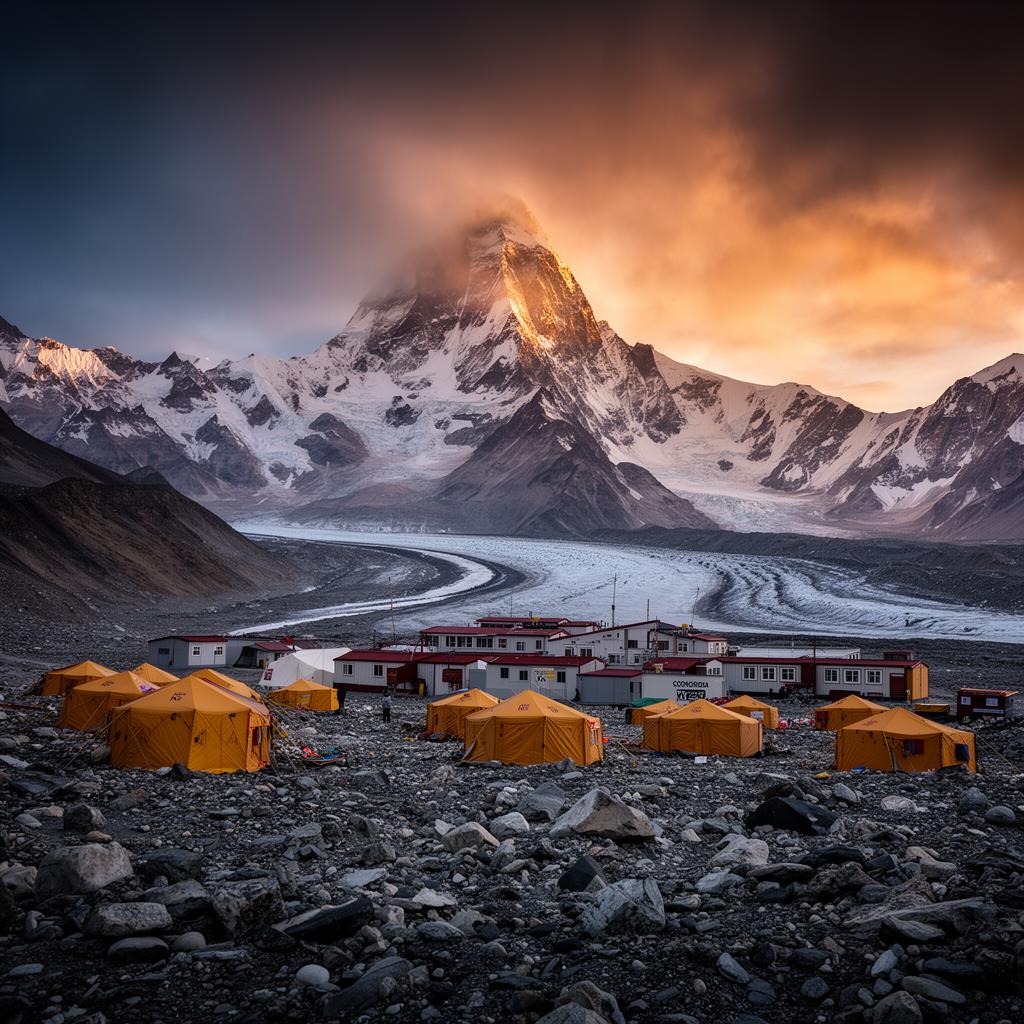
The k2 base camp trek is the great walk of Pakistan and one of the great walks of the world. Twelve to fourteen days on foot from the village of Askole in the Shigar valley to Concordia, the confluence of the Baltoro and Godwin-Austen glaciers, ringed by four of the world's fourteen 8,000-metre peaks: K2, Broad Peak, Gasherbrum I and Gasherbrum II. We run this trek every season. It is not a trip you take lightly, and this guide is written accordingly.
The trek in one paragraph
Drive Skardu → Askole (6-7 hours). Walk Askole → Jhola → Paiyu (rest day) → Khoburtse → Urdukas → Goro II → Concordia (4,600 m). From Concordia, day excursions to K2 base camp (5,150 m) and Broad Peak base camp. Return the same way, or exit over the Gondogoro La (5,585 m) into the Hushe valley, a significantly more committing option requiring fixed ropes, ice axe, harness and a separate weather window.
When to go
Mid-June to mid-September. June is greenest at the lower camps but the glacier is messier. July-August is peak and the Baltoro is busy with expeditions, the camps have a small-city feel that some love and some hate. Early September is our favourite: expeditions winding down, clear skies, cold nights but stable weather.
Difficulty and altitude
- Distance: ~110 km round trip via the Baltoro (return), ~145 km via Gondogoro La (exit).
- Maximum sleeping altitude: 4,600 m at Concordia.
- Maximum walking altitude: 5,150 m at K2 BC (or 5,585 m at Gondogoro La).
- Trail surface: moraine and glacier ice for half the trip. Crampons typically not needed for the standard route; required for Gondogoro La.
- Days walking: 12-14 (standard) or 14-16 (Gondogoro exit).
- Temperature: 20 °C lower camps midday, −10 °C Concordia night.
Standard route, day by day
- Skardu → Askole (3,000 m). 6-7 hrs drive on rough road.
- Askole → Jhola (3,200 m). 7 hrs walk along Braldu river.
- Jhola → Paiyu (3,450 m). 7 hrs through Korophon meadows.
- Paiyu, rest and acclimatisation day. Crew prepares for the glacier.
- Paiyu → Khoburtse (3,930 m). 8 hrs, first day on the Baltoro Glacier.
- Khoburtse → Urdukas (4,050 m). 4 hrs, the great Trango Towers viewpoint.
- Urdukas → Goro II (4,380 m). 7 hrs on moraine.
- Goro II → Concordia (4,600 m). 6 hrs; K2 reveals itself on approach.
- Concordia, day excursion to Broad Peak BC.
- Concordia, day excursion to K2 BC (5,150 m). The day.
- Concordia → Goro II.
- Goro II → Urdukas.
- Urdukas → Paiyu.
- Paiyu → Jhola → Askole (long day combining two stages).
- Askole → Skardu drive out.
What it costs
Standard out-and-back K2 BC trek with full support: USD 4,500-6,500 per person depending on group size and support level, on top of the standard Skardu logistics. Gondogoro La exit adds USD 800-1,200 for the fixed-rope team, ice equipment, additional permits and high camp at Ali Camp. The price difference between operators is almost always a story about porter wages, food quality, and safety margin, pick carefully.
What we provide
- High-altitude IFMGA-trained guide and assistant guides
- Full porter team to internationally agreed load and wage standards
- Cook crew and dedicated kitchen tent with hot meals three times a day
- Sleeping tents (two-person), mess tent, toilet tent
- All permits (Central Karakoram National Park, Concordia)
- Satellite phone and emergency communications
- Helicopter evacuation insurance, non-negotiable, included
- All meals on the trek; transport Skardu-Askole-Skardu
Fitness and training
This is a long, sustained, high-altitude trek on rough surfaces. You should be able to walk 6-8 hours a day for two weeks at moderate pace with a 6-8 kg day pack. Previous experience above 4,000 m is strongly recommended but not absolutely required. Train for 4-6 months: long weekend hikes, stair work, and at least one multi-day trek before you arrive.
Gear list essentials
- Down jacket rated to −15 °C
- Sleeping bag rated to −15 °C minimum
- Stiff trekking boots, broken in
- Proper waterproof shell, Goretex or equivalent
- Trekking poles, gaiters
- Glacier glasses (Cat 4), the Baltoro is brutal on the eyes
- Headtorch, spare batteries
- Personal first aid plus Diamox if you tolerate it
Honest words on risk
People die on the Baltoro most seasons. Almost always climbers, occasionally trekkers. The risks are altitude, weather, rockfall on certain sections, and the standard injuries possible on any long mountain walk. Our safety record is strong because we acclimatise properly, carry comms, insure for helicopter evacuation, and turn around when we should. We will refund and re-route rather than push through bad weather. If your operator won't put that in writing, choose another.
Q. Do I need previous trekking experience for K2 base camp?
Yes, meaningful prior experience. At minimum a multi-day high-altitude trek (Annapurna Sanctuary, EBC, Kilimanjaro). The K2 trek is longer, rougher under foot, and more remote than any of those. We turn down clients whose CV doesn't match the trip; that is a feature, not a sales loss.
Q. Can I do K2 base camp without a guide?
Practically, no. The Central Karakoram National Park requires registered guides for foreign trekkers; the route requires porters; helicopter evacuation needs a sat-phone and an insurance policy in place before you set foot on the glacier. This is not a DIY trek.
Q. How is K2 base camp different from Everest base camp?
Longer, rougher, far less infrastructure (no lodges, full camping throughout), more remote, more weather-exposed. Half of EBC is teahouses; all of K2 is tents on moraine. The mountain view at Concordia is the most concentrated cluster of giants on earth, there is no comparable view from EBC.
Q. Is the Gondogoro La worth it?
If you have the experience and the budget, yes, it turns the trek from out-and-back into a true crossing, with the most dramatic single morning of any Pakistan trek. If conditions don't allow it, we exit the way we came in. No fixed-rope crossing is worth pushing in marginal weather.
Q. What's the youngest/oldest you've taken?
Youngest 19, oldest 68. Age matters less than fitness and altitude history. We medical-screen everyone before deposit; that screening is binding, not theatrical.
Written by
Zain Karim
Head of mountain operations
Zain has run private trips through Hunza, Skardu and the Karakoram since 2019. He spends about 120 nights a year above 2,500 m and writes about the routes he guides.
Has guided the Hunza-Skardu loop more than forty times.
More from Experiences & Interests